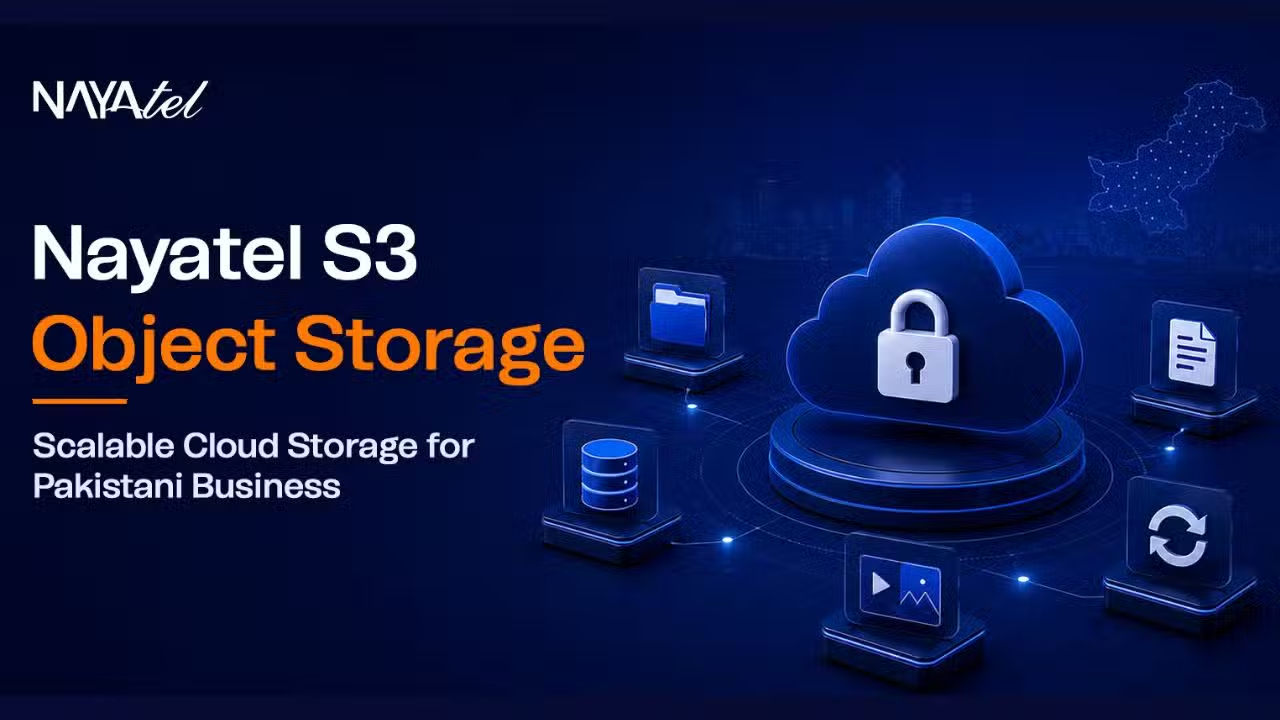
Pakistani businesses are generating and managing larger volumes of digital data than ever before. From business documents and customer records to videos, application files and artificial intelligence datasets, organizations need storage solutions that can expand with their operations.
Nayatel has entered this growing market with its S3 Object Storage service, a cloud storage solution designed to help Pakistani businesses store, access and manage large-scale data through infrastructure hosted within Pakistan.
S3 Object Storage is designed for storing different types of digital information at scale. Unlike conventional file storage systems, object storage can accommodate continuously growing datasets and is suitable for businesses that need flexible storage without constantly expanding physical infrastructure.
Nayatel’s S3 Object Storage is hosted locally in Pakistan. This can provide businesses with faster access to stored information while giving organizations greater control over where their data is physically hosted.
Local hosting can also be important for organizations concerned about data governance and regulatory requirements. Keeping business data within Pakistan can give companies greater visibility and control over their storage environment.
The service is priced at PKR 15 per GB per month, with no setup costs and no hidden charges, according to the information provided by Nayatel. The usage-based model allows businesses to pay according to their storage requirements rather than investing heavily in physical storage infrastructure upfront.
This approach can be useful for startups and smaller businesses with relatively modest storage requirements, while larger organizations can use the same platform to manage datasets reaching several terabytes.
Security is another key feature of the service. Nayatel states that stored data is protected using AES-256 encryption during upload and storage, providing an additional layer of protection for business information.
The storage infrastructure is also supported by Nayatel’s fiber network and round-the-clock technical support. Enterprise-focused monitoring and uptime capabilities are intended to help organizations keep their data accessible when required.
The potential applications of S3 Object Storage extend across several industries. Businesses can use the platform for off-site backups and disaster recovery, helping protect important information against hardware failures and other unexpected incidents.
Media companies can use object storage to manage large video and audio files, while software development teams can use it as scalable backend storage for applications and digital services.
Organizations working with surveillance systems and Internet of Things (IoT) devices can also benefit from scalable storage for large amounts of recorded footage and sensor-generated data.
Document archiving is another practical application. Companies that need to retain business records for extended periods can use scalable object storage to maintain digital archives without relying entirely on local hardware.
The growing use of artificial intelligence and machine learning also creates demand for storage capable of handling large training datasets. Object storage can provide a centralized location for these datasets while allowing organizations to expand their storage capacity as their requirements increase.
For Pakistani companies, local cloud infrastructure can offer additional advantages. Using international storage platforms may expose businesses to currency fluctuations, cross-border data transfer costs and infrastructure located far from their users.
Nayatel’s locally hosted approach keeps the data within Pakistan and allows businesses to pay in Pakistani rupees. This can make storage costs easier to predict and reduce some of the uncertainties associated with dollar-based cloud services.
As Pakistan’s digital economy continues to expand, demand for reliable and scalable data infrastructure is likely to grow. Locally hosted S3-compatible storage could provide businesses with another option for managing increasingly large digital workloads.