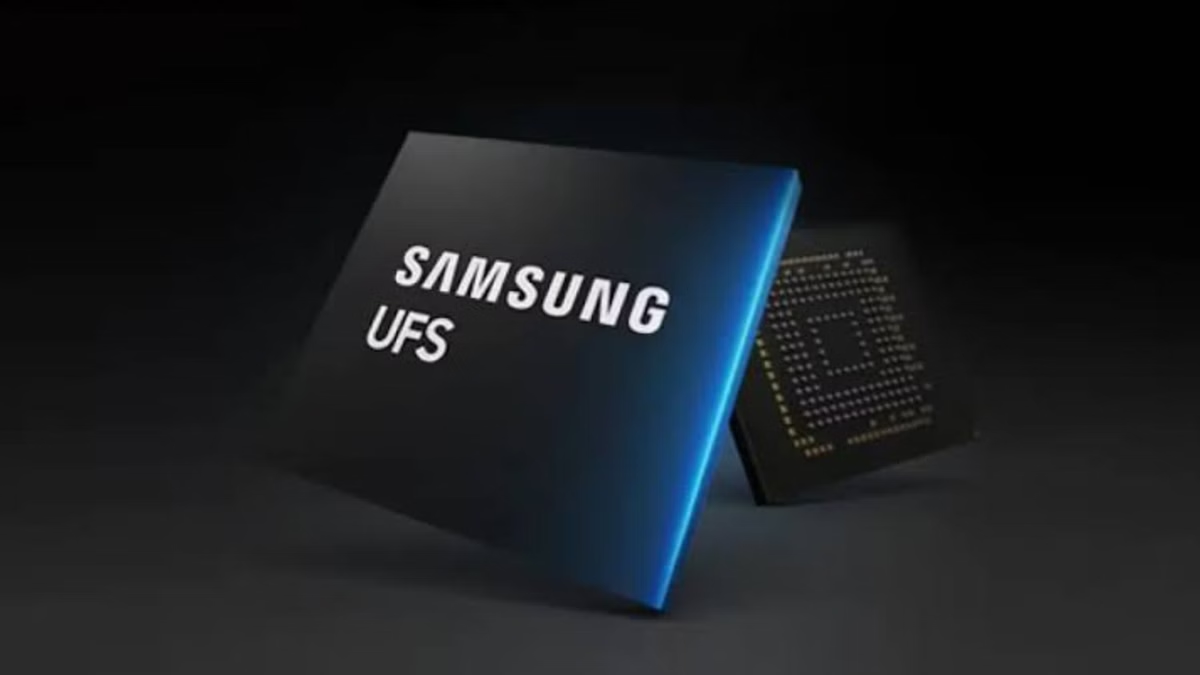
Samsung has announced its next-generation UFS 5.0 storage technology, marking a significant leap in mobile storage performance aimed at powering future smartphones, wearables, and connected devices designed for advanced artificial intelligence workloads.
The company states that UFS 5.0 delivers more than double the performance of its current UFS 4.1 standard while also improving energy efficiency and reducing physical space requirements inside devices. This development is expected to support the growing demand for faster data processing in AI-driven applications.
Modern smartphones are increasingly reliant on local processing of large AI models, high-resolution media, and complex multitasking environments. In this context, faster storage plays a crucial role in reducing loading times, improving app responsiveness, and enhancing overall system performance.
Samsung reports that UFS 5.0 achieves sequential read speeds of up to 10.8GB/s and write speeds of up to 9.5GB/s. These figures make it the fastest Universal Flash Storage solution introduced by the company to date, significantly surpassing the performance benchmarks of UFS 4.1.
The upgrade is expected to benefit a wide range of devices beyond smartphones, including wearable technology, tablets, and other connected electronics that require high-speed data access and efficient power consumption.
The technology has been developed in accordance with the latest embedded memory interface standards set by JEDEC, the global organization responsible for defining semiconductor memory specifications. This ensures compatibility with future hardware ecosystems and facilitates broader adoption across the mobile industry.
As Samsung is one of the world’s leading suppliers of memory and storage components, industry analysts expect UFS 5.0 to play a key role in shaping the next generation of flagship smartphones. Major manufacturers are likely to integrate the technology as demand grows for AI-enabled features such as real-time image processing, voice assistants, and on-device machine learning.
One of the key advantages highlighted by Samsung is improved power efficiency. As mobile devices continue to integrate more computationally intensive applications, energy optimization becomes essential to maintaining battery life without compromising performance.
The introduction of UFS 5.0 reflects the broader industry shift toward AI-centric device architecture, where storage, processing, and memory systems are optimized to handle large-scale data locally rather than relying entirely on cloud-based computing.
With the rollout of next-generation chipsets and AI-driven mobile platforms expected in the coming years, UFS 5.0 is positioned as a foundational technology that could significantly enhance user experience across the global smartphone ecosystem.