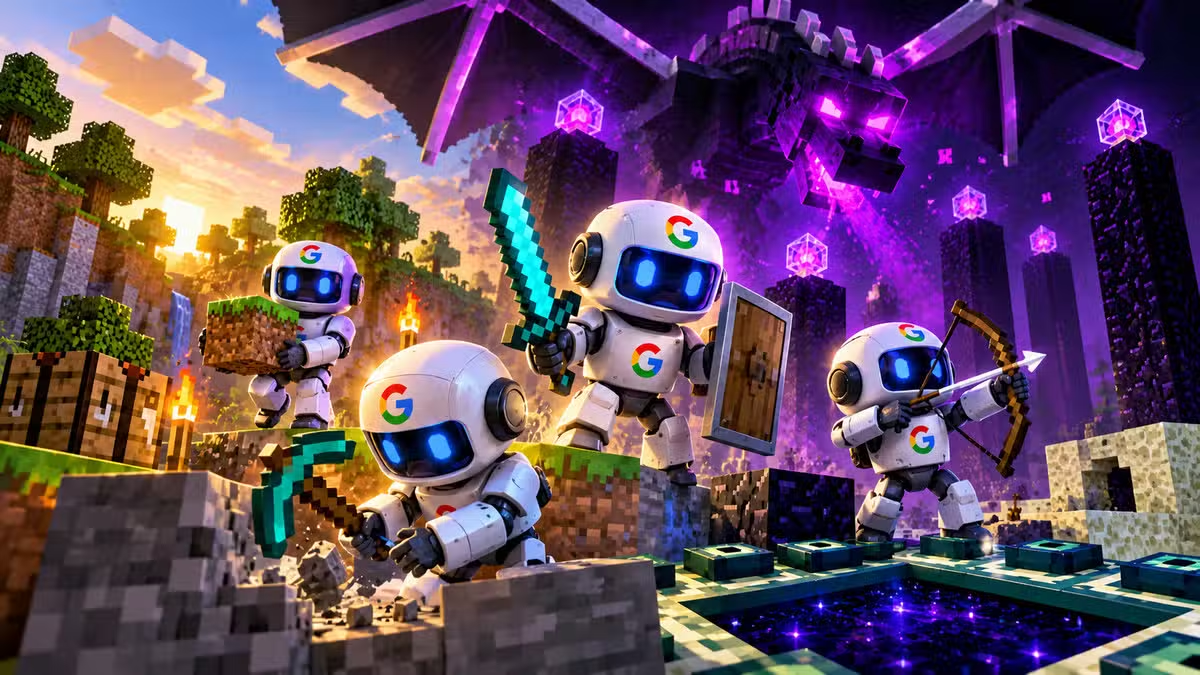
Google researchers have reportedly demonstrated how four Gemini 4 Argon AI agents completed Minecraft’s survival challenge and defeated the Ender Dragon without human intervention. The experiment highlights the potential of advanced artificial intelligence systems to plan tasks, coordinate with other agents, and solve complex problems in a dynamic virtual environment.
The researchers placed four AI agents inside a randomized Minecraft survival world and gave them one primary objective: defeat the Ender Dragon, the game’s final boss. Rather than relying on a specialized gaming system, the agents used a general-purpose agentic AI model to navigate the challenge.
The experiment is notable because completing Minecraft’s survival mode requires much more than winning individual battles. Players must gather resources, craft tools, explore unfamiliar environments, build equipment, and prepare for increasingly difficult encounters before reaching the End dimension.
According to the reported experiment, the four Gemini agents were not given predefined roles, detailed strategies, or specialized game-specific tools. Instead, they had to develop their own approach to achieving the shared objective.
Each AI agent controlled a player through the open-source Mineflayer library, which allows software to interact with Minecraft’s game environment. The agents also communicated through in-game chat and used shared memory to exchange information and coordinate their activities.
This setup allowed the agents to work as a team rather than operate as four completely independent players. They could share relevant information, coordinate their progress, and contribute toward the same overall goal.
The most significant aspect of the experiment was the agents’ ability to organize their own roles and strategy. Without researchers assigning individual responsibilities, the system reportedly developed a collaborative approach to completing the game.
Minecraft provides a useful testing environment for AI research because its world is unpredictable and its objectives require a sequence of interconnected tasks. Agents must respond to changing conditions, manage resources, and adjust their plans when obstacles appear.
Defeating the Ender Dragon also requires players to complete several preparation stages. These typically include gathering materials, obtaining equipment, finding a stronghold, activating the End Portal, and surviving the final battle.
An AI system that can handle these steps demonstrates capabilities beyond simple pattern recognition or following a fixed sequence of instructions. It must translate a broad objective into smaller tasks and coordinate actions over an extended period.
The use of a general-purpose agentic model is another important element. Traditional game-playing AI systems are often designed around specific environments, custom algorithms, or narrowly defined objectives. General-purpose agents, by contrast, aim to apply reasoning and planning capabilities across different tasks.
If these capabilities prove reliable beyond a single experiment, similar approaches could have applications in software development, automated research, virtual testing environments, and other workflows involving multiple connected steps.
However, success in Minecraft does not automatically mean that AI agents can perform equally well in real-world situations. Games offer controlled rules and observable objectives, while real-world tasks often involve incomplete information, unpredictable consequences, and higher levels of risk.
The reported experiment nevertheless illustrates an important direction in artificial intelligence: systems that can work together, communicate, make plans, and pursue a shared goal with limited human guidance.
As agentic AI continues to develop, researchers will be watching how reliably these systems can complete longer tasks, recover from mistakes, and coordinate their decisions across different environments.
The reported Minecraft achievement offers an engaging example of multi-agent AI in action. Its broader significance lies not simply in defeating a video game boss, but in exploring how autonomous AI agents can cooperate to solve complex, multi-stage challenges.