Pakistan’s shift toward solar power has accelerated rapidly in recent years. Solar panels are now increasingly visible on residential rooftops, commercial buildings and industrial facilities as consumers look for ways to manage electricity costs and reduce dependence on conventional grid power.
The growth of distributed solar has changed how many Pakistanis think about electricity generation. Instead of relying entirely on the national grid, households and businesses can generate a portion of their own power during daylight hours.
However, solar generation comes with a basic limitation: panels only produce electricity when sufficient sunlight is available.
Electricity demand, meanwhile, continues throughout the day and night. This difference between when solar power is generated and when electricity is consumed makes battery storage an increasingly important part of the renewable energy discussion.
Solar Generation Does Not Always Match Household Demand
A solar system can produce substantial electricity during the daytime, particularly during periods of strong sunlight. But many households use significant amounts of electricity after sunset.
Lights, fans, air conditioners, televisions, internet equipment, computers and kitchen appliances may continue operating well into the evening. In some homes, electricity demand can remain high even after solar generation has fallen to zero.
Without adequate storage, excess electricity generated during the day may not be available for household use later unless it is exported to the grid under the applicable arrangement.
Battery storage provides another option. Electricity generated by solar panels during the day can be stored and subsequently used when solar production declines.
In simple terms, solar panels determine how much electricity can be generated, while batteries can help determine when some of that electricity is available for consumption.
Pakistan’s Solar Market Is Moving Toward Energy Management
The initial appeal of solar power for many Pakistani consumers was straightforward: generate electricity locally and reduce dependence on grid-supplied power.
As installations increase, however, the focus is gradually expanding from generation to energy management.
A household may have sufficient solar production during the afternoon but still require grid electricity during evening hours. A battery can help bridge that gap by shifting some daytime generation into periods when the panels are no longer producing electricity.
Storage can also provide backup power during grid interruptions, depending on the battery capacity, inverter configuration and appliances connected to the system.
This makes the combination of solar panels, an inverter and battery storage more than a simple collection of individual components. The performance of the overall system depends on how effectively these technologies operate together.
Battery Choice Matters for Long-Term Solar Systems
The growing interest in energy storage has also created a new question for consumers: which type of battery is suitable for a particular solar installation?
Lead-acid batteries have historically been widely used for backup applications in Pakistan. However, lithium-based technologies have gained attention because of developments in energy density, maintenance requirements, usable capacity and expected operating life.
Consumers should look beyond the headline battery capacity when comparing storage systems.
Factors such as battery chemistry, cell quality, cycle-life rating, warranty terms, safety features, inverter compatibility and after-sales support can all influence the long-term value of an energy storage system.
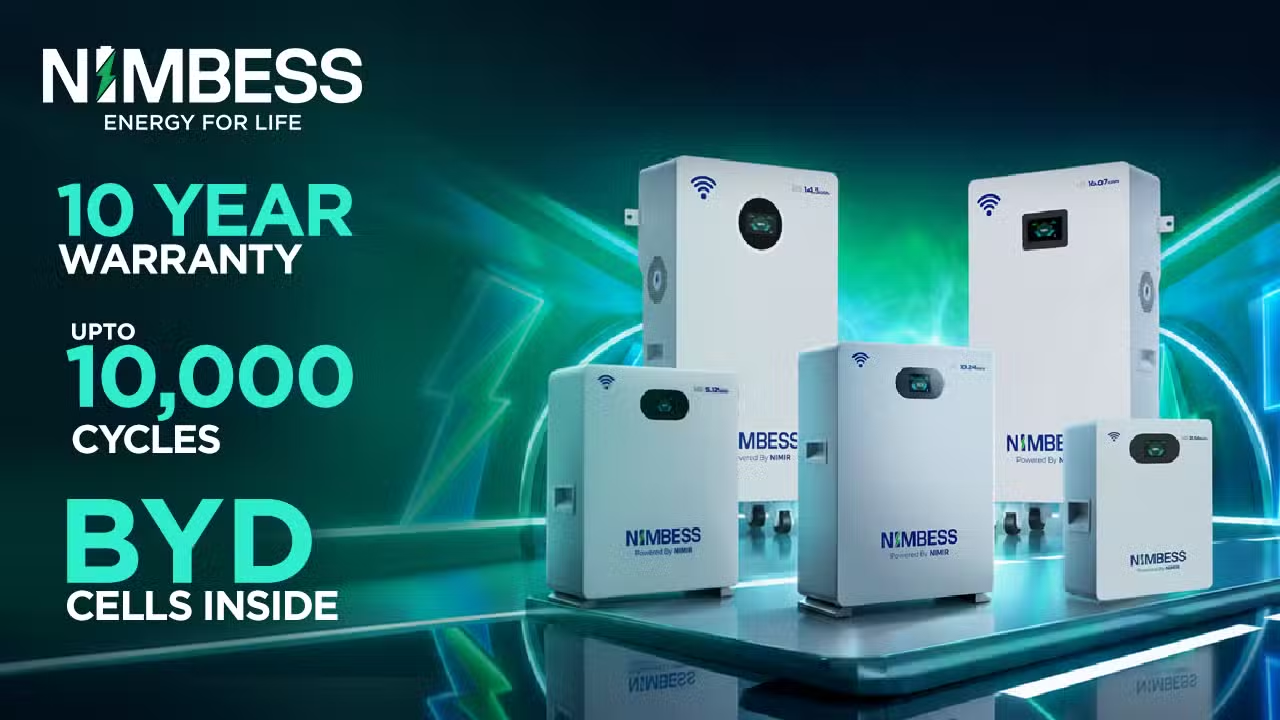
The source material also highlights Nimbess as an example of a newer lithium-ion storage offering. According to the information provided, Nimbess Pro uses Tier-1 cell technology, including BYD cells, while the company cites cycle-life capabilities reaching around 10,000 cycles across its current storage portfolio.
Such manufacturer specifications should be evaluated alongside warranty conditions, installation requirements and actual operating conditions before consumers make purchasing decisions.
A battery is potentially a long-term component of a solar installation, meaning the initial purchase price is not the only factor that determines its overall cost.
Batteries Can Increase the Usefulness of Solar Power
The value of battery storage extends beyond emergency backup.
Consider a household that generates more solar electricity than it immediately needs during the afternoon. Without storage, that additional generation may not be available to the same household after sunset.
With an appropriately sized battery, some of that energy can be retained and used later.
This can improve the ability of a household to consume its own generated electricity and reduce reliance on grid power during selected periods.
Storage can also be particularly relevant for households that require continuity for essential equipment. During a power interruption, a properly configured battery system may continue supplying connected loads until its available capacity is exhausted.
The actual backup duration depends on several factors, including battery size, load consumption, inverter configuration and the number of appliances operating simultaneously.
The Future Could Be Solar Plus Storage
Pakistan’s expanding distributed solar market is changing the country’s electricity landscape. As more consumers generate electricity themselves, the next challenge is making that generation available when it is most useful.
Battery storage addresses part of that challenge by separating the timing of electricity generation from the timing of electricity consumption.
This does not mean every solar installation necessarily requires a battery. The appropriate configuration depends on a household’s electricity consumption, budget, grid availability, existing solar system, tariff arrangement and backup requirements.
For consumers considering a new installation, understanding these factors can help them evaluate whether storage provides sufficient additional value for their particular needs.
Pakistan’s energy transition is therefore moving beyond the simple question of how much solar electricity can be generated.
The emerging question is how effectively that electricity can be stored, managed and consumed throughout the day.
Solar panels provide the generation capability. Battery storage can add flexibility by making a portion of that generated electricity available beyond daylight hours.
As the country’s renewable energy market continues to develop, this combination could become an increasingly important part of residential and commercial energy systems.