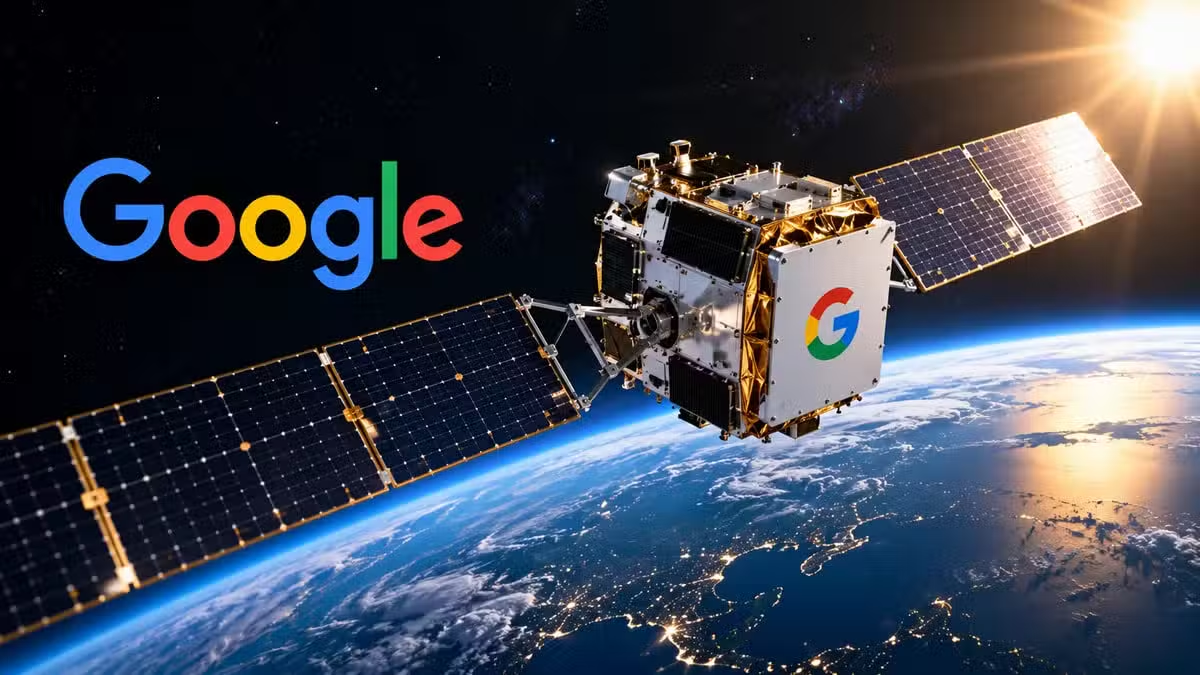
Google has achieved a significant milestone in artificial intelligence after successfully running an AI model on a satellite in space and receiving its first response back on Earth. The experiment marks an important development in the company’s efforts to explore the possibility of operating future AI computing infrastructure beyond the planet.
The achievement is part of Project Suncatcher, Google’s research initiative investigating whether artificial intelligence systems could eventually operate in space rather than depending entirely on traditional data centers located on Earth.
Google announced the successful experiment on October 30, confirming that its experimental satellite had processed an AI request while in orbit and transmitted the result back to Earth. The test demonstrates the potential for performing AI computing operations in an environment far beyond conventional data center facilities.
The experimental satellite was launched on October 1 aboard a SpaceX rocket. Since reaching space, it has undergone several weeks of testing before completing the AI processing demonstration.
The experiment represents an early step toward Google’s broader vision of developing space-based computing systems. The company is exploring whether satellites equipped with advanced computing hardware could eventually work together to support artificial intelligence applications.
Currently, most AI services depend on large data centers containing powerful processors, storage systems and cooling infrastructure. These facilities require substantial amounts of electricity and sophisticated cooling technologies to operate efficiently.
As demand for AI services continues to grow, technology companies are exploring alternative ways to expand computing capacity. Google’s Project Suncatcher investigates whether space could provide another environment for meeting some of these future computing requirements.
One potential advantage of space-based data centers is access to abundant solar energy. Satellites operating in suitable orbits could potentially collect solar power and use it to support computing operations.
However, building reliable AI infrastructure in space presents considerable technical challenges. Equipment must operate under extreme temperature variations, radiation exposure and the physical demands of launching and maintaining hardware in orbit.
Communication is another important consideration. Satellites must transmit information between space and ground stations, and the speed and reliability of these connections will influence how effectively space-based systems can support AI applications.
Google’s latest demonstration does not mean that large-scale AI data centers are ready to operate in orbit. Instead, it provides an early indication that AI processing and communication between satellites and Earth can be achieved under experimental conditions.
The company will need to address several engineering and economic challenges before such infrastructure becomes commercially practical. These include hardware reliability, maintenance, launch expenses, power management and high-speed data transmission.
Nevertheless, the successful test highlights how rapidly artificial intelligence research is expanding into new areas of technology. Project Suncatcher could contribute to future developments in satellite computing and alternative AI infrastructure.
As technology companies search for ways to support the growing demand for artificial intelligence, Google’s space-based experiment offers an early look at a possible future in which computing systems may operate both on Earth and beyond it.