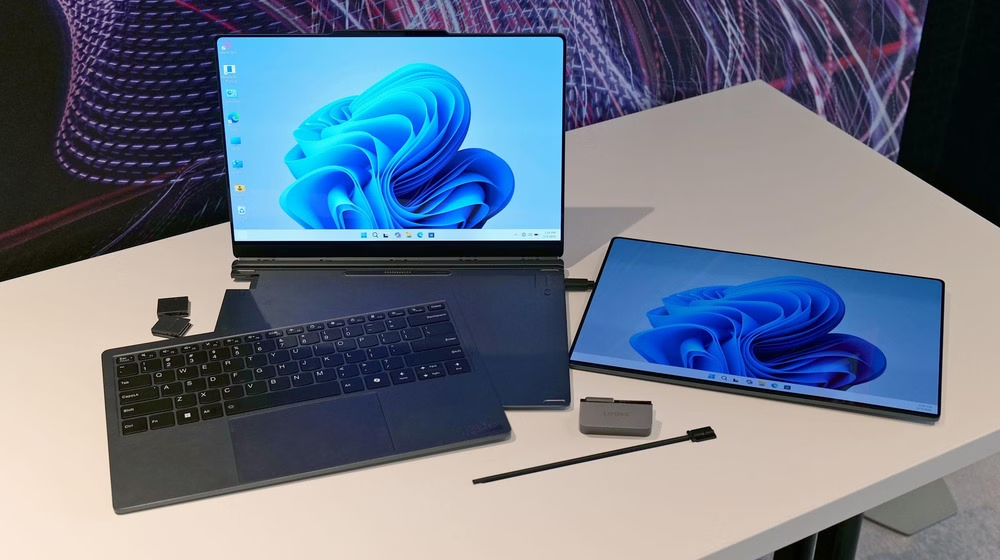
At this year’s Mobile World Congress 2026 (MWC 2026), Lenovo introduced an ambitious new Modular AI PC concept designed around flexibility and user customization.
While modular laptops have historically struggled to gain mainstream popularity, Lenovo’s latest concept pushes the idea further — not just allowing internal upgrades, but enabling users to swap major external components such as the screen, keyboard, and ports.
Built for Adaptability
The prototype centers on a 14-inch chassis engineered with hot-swappable elements. Unlike traditional laptops where most components are fixed, Lenovo’s concept allows users to change hardware modules depending on their needs.
The company is positioning the device as a future-ready platform that adapts to different workflows — from productivity and creative tasks to entertainment and collaboration.
Double-Sided Display Innovation
One of the most striking features is a secondary display integrated into the design. The laptop includes a detachable or dual-sided screen system that enables multiple viewing configurations.
Users could potentially flip, extend, or swap the display module to transform the device from a standard clamshell laptop into a multi-screen productivity setup. This opens possibilities for presentations, multitasking, or shared viewing experiences without requiring external monitors.
Detachable Keyboard and Modular Ports
The keyboard is also detachable, allowing the system to function more like a tablet or compact workstation when needed. This flexibility could appeal to professionals who alternate between desk-based work and on-the-go use.
Additionally, the concept includes modular port units. Instead of being limited to fixed USB-C, HDMI, or other connectivity options, users could swap port modules based on their requirements — whether for high-speed data transfer, additional display outputs, or specialized enterprise connections.
AI Integration at the Core
As part of Lenovo’s broader AI PC strategy, the modular device is expected to integrate on-device AI capabilities. While detailed specifications were not fully disclosed, the concept aligns with the industry’s push toward AI-enhanced productivity tools, optimized power management, and intelligent workflow assistance.
Modular laptops have appeared before, but few have achieved commercial success due to complexity, cost, and durability concerns. Lenovo’s approach attempts to overcome those limitations by designing modularity into the core architecture rather than treating it as an afterthought.
Though still a concept, the Modular AI PC highlights Lenovo’s willingness to experiment with next-generation computing designs. Whether it moves beyond prototype status will likely depend on consumer demand, manufacturing feasibility, and real-world durability testing.