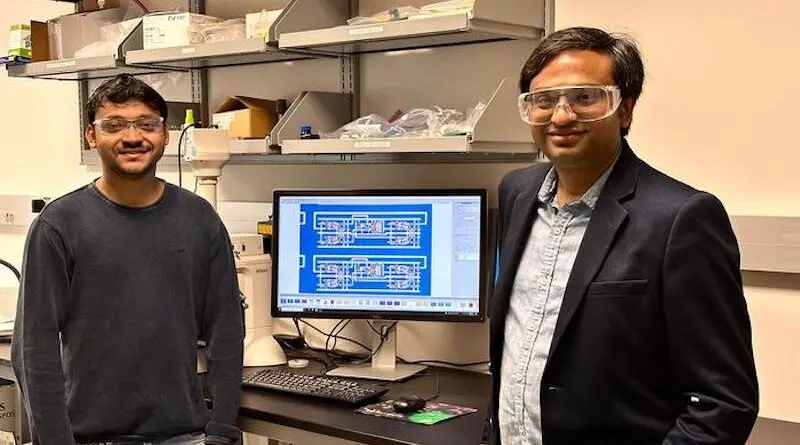
In a pioneering advancement for the electronics industry, engineers at Pennsylvania State University have unveiled the world’s first computer constructed entirely from atomically thin two-dimensional (2D) materials. The breakthrough moves the tech world a step closer to ultra-compact, low-power devices, marking a critical departure from conventional silicon-based computing.
Traditional computers rely on silicon transistors, but as components shrink in size, silicon struggles to maintain performance. Recognizing this limitation, the Penn State team built a complementary metal-oxide semiconductor (CMOS) architecture using two 2D materials: molybdenum disulfide for n-type transistors and tungsten diselenide for p-type. This unique pairing enabled the creation of fully functional logic gates without a trace of silicon.
The components were developed using metal-organic chemical vapor deposition (MOCVD), a precise technique that allows the growth of atom-thin layers of semiconductor material. Researchers successfully fabricated over 1,000 transistors for each type, carefully aligning and tuning them to create a working logic circuit.
Although the 2D computer currently operates at just 25 kilohertz, it proves that reliable computation can be achieved with materials just atoms thick. According to Dr. Saptarshi Das, professor of engineering and the project lead, the demonstration “opens the door to a future where computers could be integrated into wearable tech, medical implants, and flexible electronics.”
Lead author Subir Ghosh, a PhD candidate, emphasized that the prototype consumes significantly less power than traditional silicon-based computers, making it an attractive option for next-generation applications where energy efficiency is paramount.
This minimalistic, one-instruction-set computer isn’t meant to rival commercial processors yet—but it demonstrates that the post-silicon era is no longer theoretical.